

Where to stay in Bali: the best area for your trip
Updated June 2026 · By Karina, Wonderful Bali Villas — arranging holiday villa stays across Bali since 2018
There’s no single best place to stay in Bali — the right area depends entirely on your trip. Surfers, families with young kids, honeymooners and first-time visitors all want different things, and on an island this size the right base keeps the things you came for close, instead of an hour away through traffic. This is an honest, area-by-area guide from a team that lives here and has stayed in the villas we manage — who each area suits, who it doesn’t, and how far it really is from the things you came for.
Bali at a glance — the quickest answer
- First time in Bali: Seminyak or Sanur — easy, walkable, hard to get wrong.
- Surf + nightlife (20s–30s): Canggu.
- Cliffs, surf and sunsets: Uluwatu (the Bukit).
- Culture, jungle, slow mornings: Ubud.
- Easiest with young kids: Sanur or Nusa Dua (every area works with a bit of planning).
- Couples / honeymoon: Uluwatu or Ubud.
Bali’s main areas, one by one
Bali is big, so the right base keeps you close to what you came for rather than crossing the island for it. Here’s who each area suits, who it suits less, and roughly how far it sits from the things you came for. Each links through to our villas in that area.
Seminyak — polished, central, easy
Bali’s grown-up beach town: boutiques, beach clubs and the island’s best concentration of restaurants. Walkable, central, and the safest first-timer choice — 20–30 minutes from the airport and a short drive to everywhere else. Less raw than Canggu, calmer than Kuta. Best for first-timers, couples, and anyone who wants restaurants and shopping on the doorstep. Not ideal if you want surf culture or quiet. → Villas in Seminyak
Canggu — surf town, café culture, always on
The young, busy heart of Bali’s expat and digital-nomad scene — black-sand surf beaches, hundreds of cafés, co-working and a constant buzz. Berawa, Pererenan and Umalas are its quieter sub-areas (Pererenan is the calmer, rice-field edge). Best for surfers, remote workers and a younger crowd. Not the place for calm — traffic is heavy and it never really switches off, though young families still make it work from a villa off the main strip. → Villas in Canggu · Villas in Pererenan
Uluwatu (the Bukit) — cliffs, surf, sunsets
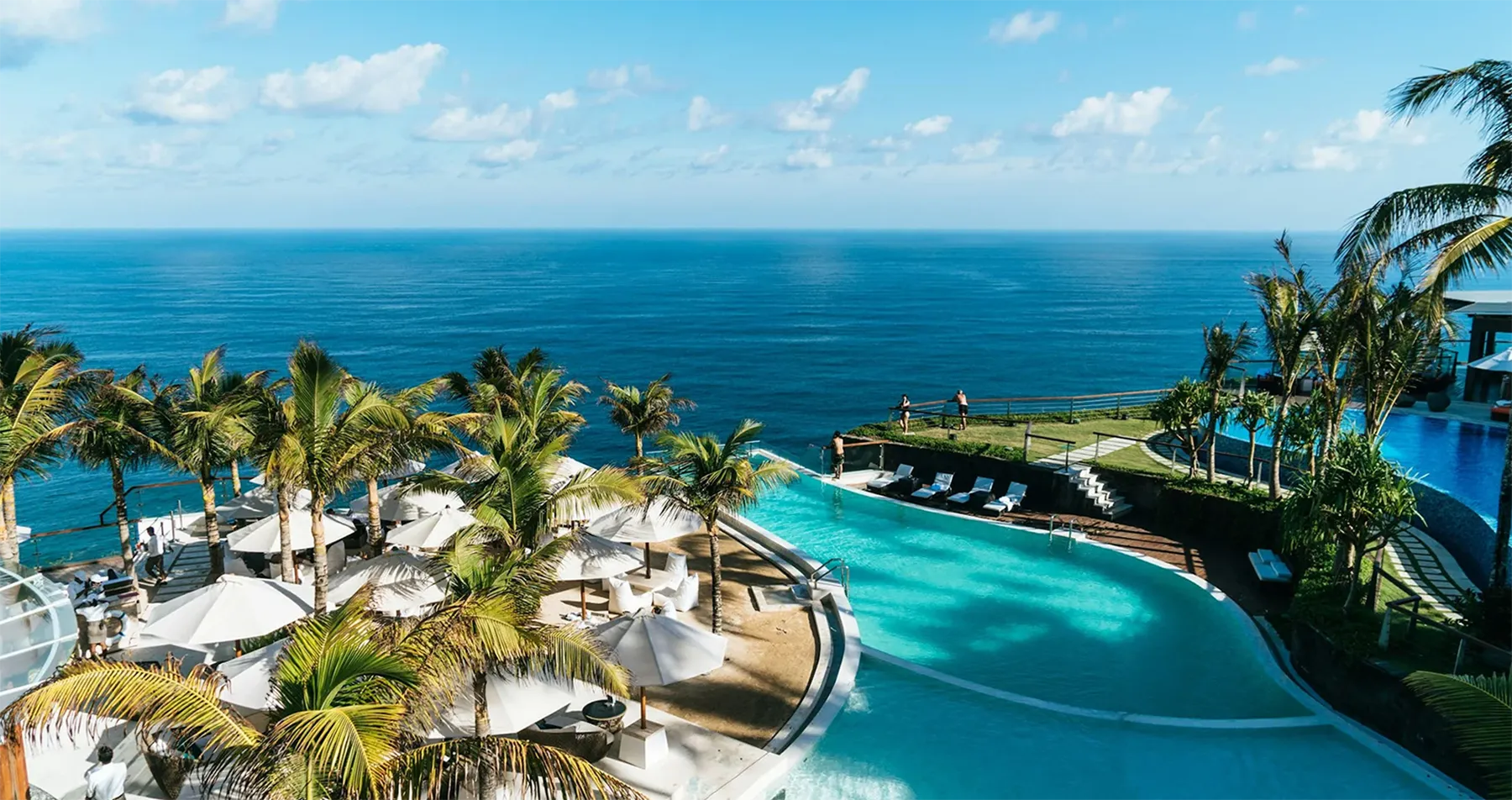
Bali’s dramatic southern peninsula: limestone cliffs, world-class reef breaks (Bingin, Padang Padang) and sunsets watched from clifftop bars. One of the closer “destination Bali” bases to the airport (around 30–45 minutes, depending where on the Bukit). Best for surfers, couples and milestone trips. It’s spread out and many beaches sit at the bottom of long cliff stairs — still fine with young kids, with a rental pool fence (ask the villa) and an easy way to get around, whether a driver, Grab/GoCar or a scooter. → Villas in Uluwatu
Ubud — culture, rice fields, jungle
Bali’s inland cultural heart — rice terraces, temples, yoga, wellness and slow mornings, about 60–90 minutes from the coast. No beach, but the most distinctly Balinese base on the island. Best for couples, wellness travellers, and the “slow half” of a split trip. Not ideal if beach time is the point of the trip. → Villas in Ubud
Sanur — calm beach, easy with kids
Bali’s original beach town and its most relaxed coast: a flat, walkable beachfront path, calm swimming water (a reef breaks the surf), and an older, quieter crowd. The easiest base for families with young children and anyone with limited mobility, and the jump-off point for the Nusa islands. Best for families, calm-beach lovers and longer, slower stays. Not ideal if you want surf or nightlife.
Nusa Dua & Jimbaran — resort calm and sunset seafood
Nusa Dua is the gated big-resort enclave on the east of the peninsula — calm-water beaches, manicured and quiet, good for families who want a resort feel. Jimbaran is the curving bay famous for sunset seafood on the sand, between the airport and the Bukit. Both are calmer and more spread-out than the surf coast.
Legian & Kuta — budget and convenience
The original tourist strip: closest to the airport, cheapest, busiest, and the most crowded beaches. Fine for a first or last night, or a tight budget; most travellers now base further north or south.
Bali’s areas compared at a glance
| Area | Best for | Beach & swimming | Family-friendly | From airport |
|---|---|---|---|---|
| Seminyak | First-timers, dining, shopping | Yes, busy | OK | 20–30 min |
| Canggu | Surfers, nomads, nightlife | Surf beaches, black sand | With planning | 45–75 min |
| Uluwatu (Bukit) | Surfers, couples, sunsets | Cliff beaches, stairs | With planning | 30–45 min |
| Ubud | Culture, wellness, couples | Inland — no beach | OK | 60–90 min |
| Sanur | Families, calm, long stays | Calm, swimmable | Excellent | ~40 min |
| Nusa Dua & Jimbaran | Resort calm, families, seafood | Calm bays | Excellent | 20–40 min |
| Legian & Kuta | Budget, convenience | Busy, crowded | OK | 10–20 min |
Match the area to what you came for
Part of what makes Bali special is how much it packs in — surf and diving, volcanoes and rice paddies, wellness and nightlife, temples and a fast-growing sports scene. Where you base depends a lot on what you’re here to do.
- Surf: Canggu for beginner-friendly beach breaks; Uluwatu for world-class reef breaks.
- Diving & snorkelling: the east and the islands — Amed and Tulamben (the USAT Liberty wreck) in the northeast, and Nusa Lembongan / Nusa Penida off the southeast for manta rays and mola-mola. Most divers base out east or day-trip from Sanur.
- Yoga, wellness & spirituality: Ubud is the island’s wellness capital — yoga shalas, retreats, healers and healthy cafés.
- Mountains & sunrise: the inland volcanoes — sunrise treks up Mount Batur and the cooler highlands around Munduk and Kintamani. Base in or near Ubud.
- Nightlife & beach clubs: Seminyak, Canggu and the Uluwatu clifftop sunset bars.
- Sport & fitness: gyms across the south, a booming padel scene (Bali is now one of Asia’s padel hubs) and several golf courses around Nusa Dua, the Bukit and Tabanan.
- Temples & culture: island-wide — the Uluwatu and Tanah Lot sea temples, and Ubud for arts, dance and ceremonies.

Where to stay by traveller type
- First time in Bali: Seminyak (lively, central) or Sanur (calm, easy). Both are forgiving — walkable, plenty of food, short airport transfer.
- Families with kids: Sanur and Nusa Dua are the easiest — calm, swimmable water and flat, pram-friendly streets — but every area works with a little planning, including Canggu and Uluwatu. Most villa pools are unfenced, so with toddlers ask the villa to arrange a rental pool fence (widely available). Getting around with kids is easy too — a private driver, Grab/GoCar, a rental car, or a scooter if you’re confident. A stroller can be hit-and-miss on Bali’s pavements, but it’s manageable, and facilities keep improving everywhere.
- Couples / honeymoon: Uluwatu for cliffs and sunsets, or Ubud for jungle and privacy.
- Digital nomads / long stays: Canggu and its quieter edges (Pererenan, Umalas) for the best café/co-working density; Sanur for a calmer long stay.
- Luxury: Uluwatu’s cliff villas and Ubud’s jungle estates sit at the top end.
- Budget: Legian/Kuta, or shoulder-season villas inland.
Best time of year to visit
Dry season (roughly April–October) is the classic time to come: sunshine, lower humidity and the best surf on the west coast and the Bukit. It’s also the busiest and priciest — July, August and the Christmas/New-Year weeks are peak, so book villas well ahead.
Wet season (roughly November–March) is hot and humid with daily downpours — usually short and heavy, often in the afternoon, with plenty of sun in between. Fewer crowds, lower villa prices and the greenest landscapes. The shoulder months (April–June, September–October) are the sweet spot: good weather, thinner crowds and better value.
One date to know: Nyepi, the Balinese Day of Silence (usually March), when the whole island shuts down for 24 hours — no flights, no going out, lights kept low. Remarkable if you’re prepared for it, a shock if you’re not.
For the full month-by-month breakdown — weather, prices, crowds and the exact 2026 festival dates — see our guide to the best time to visit Bali.
Getting around Bali & airport transfers
The airport (DPS) sits in the south near Kuta, so most areas are a manageable transfer — but traffic is the real constraint, and the south clogs up. Always pad your journey times.
- Private drivers are cheap and the easy way to get around or day-trip — roughly IDR 700,000–900,000 for a full day with a car.
- Ride apps (Grab, Gojek) cover the south for cars and scooters, though some areas restrict pickups — you may need to walk to a main road.
- Scooters are how many locals and nomads get around: cheap and freeing, but the traffic is chaotic — only if you’re confident and properly licensed.
- Rental cars are available if you’d rather self-drive, though many visitors find a driver simpler given the traffic.
- Airport transfers: pre-book one. Arrivals are hectic, and a booked driver waiting for you is worth it after a long flight.
How long, and how many areas?
There’s no rule here — it depends on how you like to travel. Plenty of guests pick one base for the whole week, often in the south, settle in and day-trip out to the rest of the island; it’s the least hassle, especially with a family, and a good villa makes staying put a pleasure. Others prefer to split the week — a few nights inland in Ubud and a few on the coast is the classic combination — to wake up on two different sides of Bali. Both work well. If anything, we’d just suggest not changing base too often — transfers between areas take longer than the map suggests, so you get more out of each spot by settling in for a few nights. For 10–14 days, two or three bases feel comfortable.
Why a villa, not a hotel
For most Bali trips a private villa beats a hotel room on both space and value: your own pool, a kitchen, often daily housekeeping and a private team — usually for less than an equivalent hotel suite. It’s especially good for families and groups, who get separate bedrooms and a shared living space instead of a row of rooms, and it swaps the resort bubble for a quieter, more local, residential feel.
The trade-off is that you arrange your own transport and meals rather than leaning on a front desk — so the team behind the villa matters. We hand-pick the villas we manage, rent them direct with no booking fees, and keep local support on hand for exactly that. Browse our villas →
Staying longer than a holiday?
This guide is about visiting — the best area for a trip. If you’re thinking of moving to Bali or renting for months rather than nights, the calculation is different (you’ll weigh community, cost of living and getting around over beach access and nightlife). For that, see our companion guide on where to live in Bali.
Where to stay in Bali — common questions
01Where is the best place to stay in Bali for the first time?
Seminyak or Sanur. Both are walkable, central and forgiving, with easy airport transfers and plenty of restaurants — you don’t need local knowledge to enjoy them.
02Where should families with young kids stay in Bali?
Sanur and Nusa Dua are the easiest — calm, swimmable water and flat, walkable streets — but every area works with a little planning, including Canggu and Uluwatu. Most villa pools are unfenced, so with toddlers ask the villa to arrange a rental pool fence (widely available). Getting around is easy with a private driver, Grab/GoCar, a rental car or a scooter. A stroller can be hit-and-miss on the pavements, but it’s manageable, and things keep improving everywhere.
03Which area of Bali has the best nightlife?
Seminyak for beach clubs and bars, Canggu for a younger surf-and-party scene, and Uluwatu for clifftop sunset bars. Sanur, Nusa Dua and Ubud are the quiet alternatives.
04Which area of Bali has the best surf?
Canggu for accessible beach breaks and a younger scene; Uluwatu for world-class reef breaks suited to confident surfers.
05Where should I stay for a wellness or yoga trip?
Ubud — it’s Bali’s wellness capital, with yoga shalas, retreats, healers and healthy cafés. For diving instead, base out east around Amed and Tulamben, or visit Nusa Lembongan.
06Is it better to stay in one area or move around?
It depends how you like to travel. Many guests happily base in one area for the whole week — often in the south — and day-trip out, which is the least hassle, especially with a family. Others split into two bases, classically a few nights in Ubud plus a coastal area. Both work; if anything, we’d just suggest not changing base too often — transfers take longer than the map suggests, so you enjoy each area more by settling in.
07What is the cheapest area to stay in Bali?
Legian and Kuta, and inland or Ubud-fringe villas, are the most affordable; Sanur is good value next to Seminyak or Canggu. Prices also drop in the wet and shoulder seasons.
08How many days do you need in Bali?
A week is enough to enjoy two bases without rushing; 10–14 days lets you add a third area or a night on the Nusa islands.
09When is the best time to visit Bali?
The dry season (roughly April–October) has the best weather but the biggest crowds and prices. The shoulder months (April–June, September–October) are the sweet spot for weather, value and fewer people; the wet season is cheaper and greener with short daily downpours.
10How far is everything from the airport?
Roughly: Seminyak 20–30 minutes, Uluwatu and Jimbaran 30–45, Sanur around 40, Canggu 45–75, and Ubud 60–90. Traffic is the variable — always pad your transfer time.
Next steps
 Best time to visit BaliMonth-by-month weather, prices and crowds.
 Browse our villasHand-picked private villas, direct-bookable, no fees.
 Villas in CangguSurf, cafés and the nomad scene.
 Villas in UluwatuCliffs, reef breaks and sunsets.
 Villas in UbudRice fields, jungle and slow mornings.
Still not sure which area fits your trip? Tell us who’s coming on WhatsApp →