
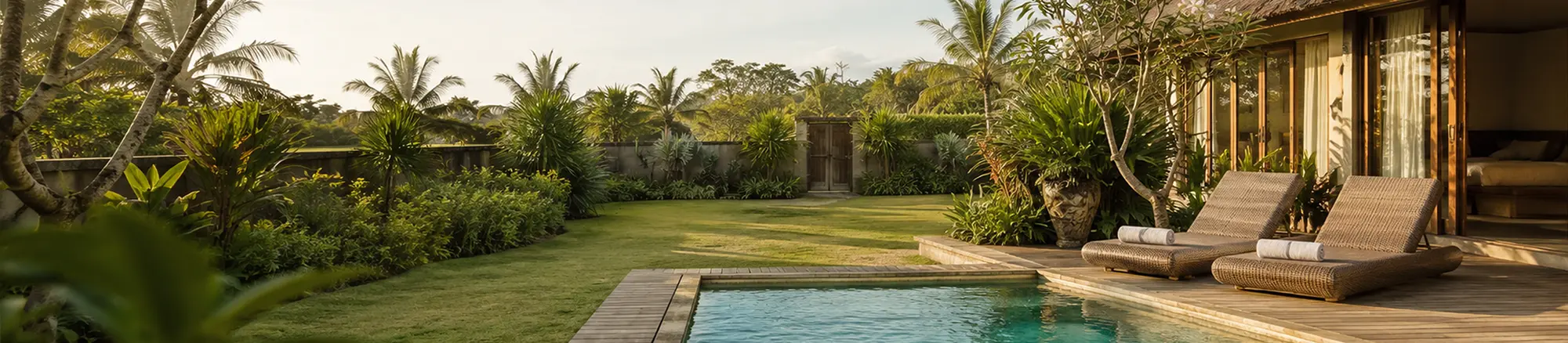
Retire in Bali: an honest 2026 guide
Updated July 2026 · By Karina, Wonderful Bali Villas long-stay team — placing long-stay tenants across Bali since 2018
Retiring in Bali is more achievable, and more ordinary, than the brochures suggest — but it pays to know the real numbers and rules before you fall for the sunsets. We house relocating retirees and older couples in long-term villas across the island, so this guide sticks to what actually matters: why people come, the visa, the honest monthly cost, healthcare, where retirees settle, tax, and the simplest way to get a home.
The essentials
- Budget: a single retiree lives well on $1,500–2,200/mo, a couple on $2,350–3,450 — roughly 40–60% below a comparable life in Australia, the UK or Western Europe.
- Visa: the E33F Retirement KITAS — age 55+, income ≥ $3,000/mo, health insurance and a Bali address.
- Best areas: Sanur for calm, flat streets and hospitals; Ubud for wellness and cooler air.
- Healthcare: capable private hospitals (BIMC, Siloam) plus a new Sanur hospital — insurance is essential.
- Housing: a yearly villa lease is the simplest, cheapest way in (and counts toward the visa).
- Tax: residency can follow from 183+ days or an intention to reside (a long-term lease counts as evidence); treaties can relieve double taxation depending on your country and income.
The short answer
The short version: a single retiree lives comfortably in Bali on about $1,500–2,200/month and a couple on $2,350–3,450 — roughly 40–60% below a comparable life in Australia, the UK or Western Europe. The usual route is the E33F Retirement KITAS (age 55+, proof of income of at least USD 3,000/month, health insurance, and a Bali address). Sanur and Ubud are the long-standing retiree favourites. Most retirees simply lease a villa long-term — which is also part of the visa requirement, so it’s the natural first step. Figures are indicative, at IDR 18,000 = USD 1 (July 2026); visa, tax and health rules change, so confirm the current detail with a licensed agent before you commit.
Why retirees choose Bali
People don’t relocate for paperwork; they relocate for a life. What keeps retirees in Bali, in roughly the order they tend to mention it:
- The climate. Warm year-round, with no winter and only moderate seasonal variation — easy on stiff joints, and an outdoor life by default.
- Help at home. A cleaner, gardener or cook is affordable and normal here, which removes much of the daily grind that makes ageing at home hard.
- Wellness as routine. Yoga, daily walks, fresh food and a $10 massage aren’t a treat — they’re Tuesday.
- A ready-made community. Sanur and Ubud in particular have settled, sociable expat circles, so you’re not starting from zero.
- Your money goes further. A pension that feels tight at home can fund a private-pool villa, dining out and household help here.
Bali rewards a local lifestyle and punishes an imported one — the retirees who thrive are the ones who lean into warungs, markets and slow mornings rather than recreating home at import prices. None of this is paradise-brochure fantasy; it’s just a calmer, warmer, more affordable version of ordinary life.
The Bali retirement visa: E33F KITAS
Last checked: August 2026. Immigration and tax rules change — verify the current requirements with a licensed agent before acting on them.
The standard route for retirement in Bali is the E33F Retirement KITAS (the current version of the older C319 retirement permit) — a one-year, multiple-entry stay permit that you renew annually. The headline conditions, per the Indonesian immigration listing and Bali visa agents in 2026:
| Requirement | E33F Retirement KITAS |
|---|---|
| Minimum age | 55 |
| Income | Proof of income / pension of at least USD 3,000 / month |
| Bank statement | Last 3 months showing at least USD 2,000 (in your name or your sponsor’s) |
| Health insurance | Required — valid for treatment in Indonesia |
| Bali address | A rental or lease agreement for a home in Bali, plus a local sponsor / caretaker |
| Work | Not permitted — no employment or selling goods or services in Indonesia |
| Duration | 1 year, multiple entry, renewable annually |
| Cost | Govt fee ~IDR 7M (~$390); all-in via an agent ~IDR 14.5M (~$800); renewal ~IDR 11M (~$610) |
Requirements and fees can change — always verify the current position with a licensed agent before applying.
A few things worth understanding. First, the age floor: you’ll see both “55” and “60” quoted online because there are two different permits — 55 applies to this E33F, while the separate E33E “Silver Hair” visa requires 60+. The income test is the core requirement — a pension, investment income or steady deposits all work, shown alongside a recent bank statement. You also need a place to live in Bali with a rental agreement and a local sponsor; how the “caretaker” element is satisfied varies in practice — often via your landlord or household help — so confirm the current interpretation with your visa agent. And the permit does not let you work or earn income inside Indonesia — running a rental property as a business is a different visa and structure.
After several continuous years of living in Indonesia on a KITAS, KITAP (permanent residency) may become available — it removes the annual renewal but carries its own conditions. Don’t plan around it without checking your specific case.
This is YMYL territory, so treat the figures above as indicative. Immigration rules and fees change and individual cases vary — use a licensed visa agent and verify the current requirements before you make plans. Sources: Indonesian Directorate General of Immigration (E33F) and licensed Bali visa agents; current as of July 2026. For the full set of long-stay visa routes, see our moving to Bali guide.
Retiring before 55 — or without a pension: the Second Home Visa (E33)
The E33F has an age floor of 55 and leans on pension income. If you don’t fit — early retiree, or your money sits in savings rather than a pension — the Second Home Visa (E33) is the other serious long-stay route. It has no age requirement and no sponsor; it qualifies on money alone.
| Requirement | E33 Second Home Visa |
|---|---|
| Minimum age | None |
| Proof of funds | IDR 2 billion (~USD 130,000) deposited in a state-owned Indonesian bank in your name — or Indonesian property worth USD 1 million |
| Deadline | 90 days after approval to place the deposit, or the visa lapses |
| Duration | 5 or 10 years — no annual renewal |
| Sponsor | Not required |
| Family | Spouse and children can join on linked E31 permits |
| Work | Not permitted — same as the E33F |
The deposit sits in an account in your own name and earns interest; the money remains yours, but it stays committed under the visa’s conditions for as long as the permit runs. The trade-off is plain: the E33F costs a few hundred dollars a year but asks for monthly income; the Second Home Visa asks for a large sum parked, and in return drops the age test and the annual renewals. As with the E33F — verify the current requirements with a licensed agent before committing money.
What retiring in Bali costs
Bali gives retirees noticeably more for their money than most Western countries — mostly on housing, household help, dining and wellness. Realistic 2026 monthly ranges:
| Lifestyle | Single / month | Couple / month |
|---|---|---|
| Comfortable | $1,500–2,200 | $2,350–3,450 |
| Premium | $2,500–3,500 | $3,800–5,500 |
| Luxury | $4,000+ | $6,000+ |
To make that concrete, here’s where a comfortable retired couple’s ~$3,200/month tends to go — in a calmer area such as Sanur or Ubud, adjusting the lines to your own life:
| Line | Monthly (couple) |
|---|---|
| Villa (2-bed, private pool, calmer area, longer lease) | $1,600 |
| Utilities & internet | $150 |
| Food (mix of local & Western) | $500 |
| Healthcare & insurance (two adults) | $350 |
| Household help (cleaner / gardener) | $200 |
| Transport (scooter, Grab, occasional driver) | $150 |
| Visa (spread over the year) | $70 |
| Leisure & wellness | $200 |
| Total | ~$3,200 |
A couple sharing one villa doesn’t pay double, since rent and bills are shared. For the full line-by-line detail across every area, see our cost of living in Bali guide.
Healthcare for retirees
Healthcare is most retirees’ first real question, and the picture is improving fast. Bali now has a real spread of capable hospitals: private, expat-facing options such as the BIMC and Siloam groups (Kuta, Nusa Dua, Denpasar); the large public referral and teaching hospital in Denpasar, RSUP Prof. Ngoerah (long known as Sanglah), which handles complex and emergency surgery including orthopedics; and a new international hospital that opened in Sanur in 2025. Routine and many moderate medical needs can be handled privately in Bali at far lower out-of-pocket cost than in Australia, the UK or the US:
| Service | Bali | Australia / UK |
|---|---|---|
| GP consultation | $15–40 | $60–150 |
| Specialist consultation | $40–100 | $150–400 |
| Dental cleaning | $20–40 | $100–250 |
| MRI scan | $150–350 | $500–2,000 |
| Health insurance | a few hundred to several thousand $/year — heavily dependent on age, coverage and pre-existing conditions | — |
Indicative out-of-pocket prices; actual costs vary by hospital, equipment and insurance.
Two honest notes. First, for the most specialised procedures some retirees still travel to Singapore (a 2.5-hour flight) — but Bali’s hospitals are closing that gap quickly, so keep health insurance with evacuation cover (also required for the visa) and you’re well placed. Second, prices vary by hospital, package and sometimes your residency status and insurance, so confirm the rate and what’s covered before any treatment. Get quotes before you move, declare pre-existing conditions, and check any specialist medication you rely on is available locally.
Where retirees live in Bali
Each area gives a different retirement. The right one depends on your mobility, how social you want to be, and whether you’ll drive or ride. Indicative long-term rent is for a one- to two-bedroom villa; see our where to live in Bali guide for the full picture.
| Area | Rent (1–2 bed villa) | Feel | Best for |
|---|---|---|---|
| Sanur | $1,100–2,800 | Flat, calm, beach promenade, new hospital | Mobility, calm, an established retiree community |
| Ubud | $1,000–2,500 | Hilly, jungle, wellness, cooler | Active retirees, wellness and culture |
| Seminyak | $1,100–3,000 | Urban, walkable, dining | Social retirees who want convenience |
| Canggu | $1,100–3,500 | Busy, young, surf and cafes | Active retirees who like the energy |
| Uluwatu | $1,400–3,800 | Clifftop, scenic, spread out | Fit retirees who drive and want peace |
Browse long-term villas in Sanur, Ubud, Seminyak, Canggu or Uluwatu →
Sanur is the retiree default, and for good reasons: flat terrain you can walk and cycle safely, the new international hospital, a calm beachfront and a ready-made community. Ubud suits more active retirees drawn to wellness and culture, with the trade-off of hills and a longer trip to a full hospital. And for the truly unhurried, retirement living in North Bali — Lovina and the coast around Singaraja — offers calm black-sand beaches and noticeably lower rents, with the trade-off of a roughly three-hour drive to the southern hospitals and the airport.
Community matters as much as climate — especially if you’re moving as a single retiree, a widow or widower, or a couple arriving without a network. Part of why Sanur endures with retirees isn’t the beach; it’s the ready-made social life: morning walking groups along the promenade, hobby and language clubs, volunteer circles and long-established expat networks that make it easy to find your feet. Ubud has its own wellness- and arts-centred crowd. Wherever you land, the social side tends to form faster here than people expect.
Long-term villas for retirees
Most retirees rent rather than buy, and the practical first step is browsing long-term villa rentals in Bali in the two or three areas that fit your mobility and pace. We list monthly and yearly villa rentals across Sanur, Ubud and beyond, and a yearly lease also gives you the Bali address and rental agreement commonly used when preparing a retirement visa application. Tell us your budget and we’ll send a retiree-friendly shortlist — single-storey layouts, quieter lanes, close to a hospital.
Renting vs buying a home
There are two honest paths to a retirement home in Bali, and for most people one is clearly simpler.
Leasing a villa long-term
Renting needs no company and no large capital — you take a one- or two-year lease (often longer by negotiation), pay a deposit, and move in. It keeps your money liquid, lets you change areas as you settle, and a rental agreement is part of the retirement-visa requirement anyway. For most retirees this is the right first move, and it’s what we arrange every week — browse long-term villa rentals or tell us your budget and we’ll send a shortlist.
Buying property
Foreigners can’t hold freehold land directly, so depending on the property, buying means a long leasehold (typically 25–30 years, no company needed), qualifying Hak Pakai (right-to-use) title on certain properties, or acquiring through a PT PMA company structure — which adds setup cost, paid-up capital and annual compliance. Some retirees do buy, and a few buy two villas to live in one and rent the other; it can work, but it’s a real undertaking. If you’re weighing it, start with our villa buying guide and our villas for sale.
Our honest steer: lease first, buy later if at all. Spend a year actually living in an area before tying up capital in it.
If the numbers are what will decide it for you, our Bali villa investment guide breaks down what villas here actually return after costs — with three real villas as examples.
Tax for retirees
Tax is the part people most often get wrong, and it’s more nuanced than the often-quoted 183-day rule: Indonesia can treat you as a tax resident if you reside here, spend more than 183 days here in any 12-month period, or show an intention to reside — and a long-term rental agreement can count as evidence of that intention. How your pension, investments and foreign income are then treated varies a lot by nationality and source. Indonesia has double-tax treaties with many countries that can provide relief, but a treaty doesn’t automatically mean you owe nothing here — the outcome depends on your country and the type of income. Anyone planning a long-term retirement here should get advice from a qualified Indonesian tax adviser before relocating — it’s inexpensive relative to the risk of getting it wrong.
Before you go: a retiree checklist
A simple order of operations that saves stress:
- Visa — engage a licensed agent 2–3 months ahead; prepare income proof, a 3-month bank statement, passport and an active health-insurance policy.
- Health insurance — get quotes from several international insurers, declare pre-existing conditions, include evacuation cover, and activate it before you fly.
- Money — tell your home bank, set up a multi-currency account (e.g. Wise), and bring a backup card.
- Medication — check your prescriptions are available locally and bring a few months’ supply.
- Housing — line up a long-term villa (you’ll need the rental agreement for the visa) rather than committing to a purchase sight unseen.
One thing we’ve learned placing retirees: most people don’t know which area truly suits them until they arrive. Tell us your budget, mobility needs, healthcare priorities and the pace you want, and we can usually narrow it to two or three areas — and the villas in them that actually fit.
Next steps

Common questions about retiring in Bali
01How much money do you need to retire in Bali?
A single retiree lives comfortably on about USD 1,500–2,200/month and a couple on USD 2,350–3,450, covering a private-pool villa, a mix of local and Western dining, transport, insurance and some household help. It’s less without a private pool, and more for premium areas. See our cost of living guide for the full breakdown.
02What visa do I need to retire in Bali?
The E33F Retirement KITAS: age 55+, proof of income of at least USD 3,000/month, a recent 3-month bank statement, active health insurance, and a Bali address with a rental agreement and local sponsor. It runs a year at a time and is renewable; after several continuous years, permanent residency (KITAP) may become available. Rules change — confirm the current detail with a licensed visa agent.
03Can Americans (or other foreigners) retire in Bali?
Yes. The retirement route is open to most nationalities who are 55+ and meet the income requirement — Australians, British, Dutch, Germans and Americans are all common. Your home-country tax position is the main thing to check, ideally with an adviser.
04Can you retire in Bali on a budget?
Yes. A careful single retiree can live on roughly USD 1,500/month, and less again in a simple villa or apartment without a private pool, eating mostly local food. Bali rewards a local lifestyle and punishes an imported one.
05Is healthcare in Bali good enough for retirees?
Increasingly, yes — and improving fast. Private expat-facing hospitals (BIMC, Siloam) and the large public Prof. Ngoerah / Sanglah referral hospital in Denpasar handle most needs, including complex surgery, and Sanur gained a new international hospital in 2025. For the most specialised care some still choose Singapore. Health insurance with evacuation cover is essential and required for the visa.
06What is the best area in Bali for retirees?
Sanur is the most popular: flat and walkable, a new international hospital, calm beaches and an established community. Ubud suits more active, wellness-minded retirees who don’t mind hills. Seminyak and Canggu are livelier; Uluwatu is scenic but spread out and needs a car.
07Do retirees pay tax in Bali?
Usually, yes in some form: Indonesia treats you as a tax resident if you reside here, spend 183+ days here in any 12 months, or show an intention to reside (a long-term lease counts as evidence). Treaties can provide relief from double taxation depending on your country and income type — use a qualified Indonesian tax adviser before relocating.
08Should I rent or buy a villa to retire in Bali?
Most retirees lease a villa long-term — it needs no company, ties up no capital, lets you change your mind, and a rental agreement is part of the visa anyway. Buying means a long leasehold, qualifying Hak Pakai (right-to-use) title, or a PT PMA company with setup and compliance costs. Our steer: lease first. See long-term rentals and the buying guide.
09Is Bali safe for retirees?
Generally, yes — violent crime against foreigners is rare. The real risk is road traffic, so be cautious on a scooter or use a driver. Sanur and Ubud are among the calmest, lowest-traffic areas.
10Can I retire in Bali before 55?
Yes — just not on the retirement KITAS, which requires age 55. The usual route is the Second Home Visa (E33): no age floor, a 5- or 10-year stay, qualified by an IDR 2 billion (~USD 130,000) state-bank deposit or USD 1 million in Indonesian property instead of pension income.